Digital pinhole
Skink Pinhole Lens and DIY Body Cap Pinholes for Canon and Sony NEX
Digital pinhole photography with a Skink pinhole lens or a home-made body cap for Canon and Sony NEX cameras: hole sizes, exposure, sensor dust, pros and cons.
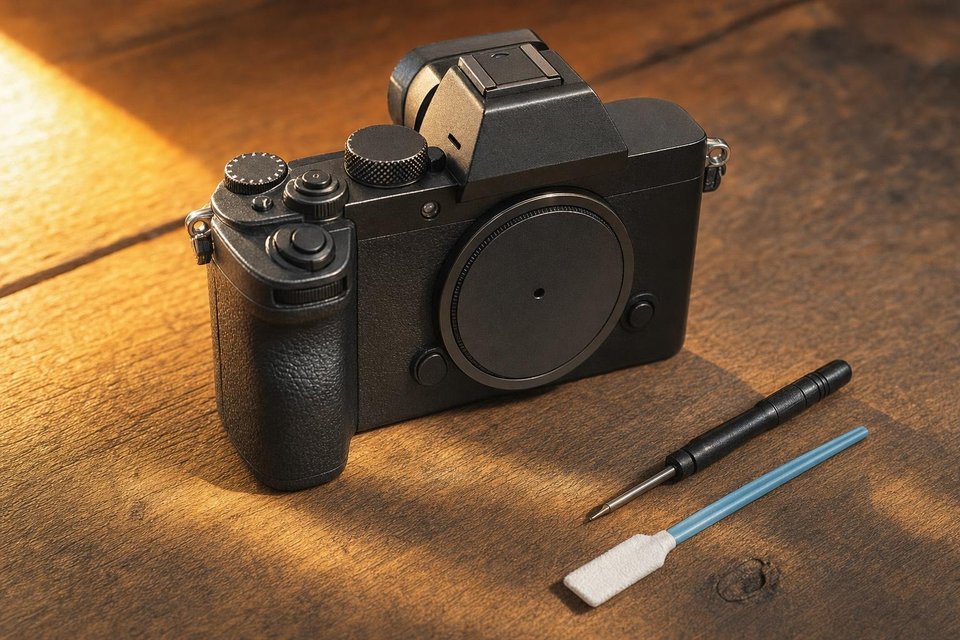
A digital camera makes a very good pinhole camera. Take the lens off, put a cap with a tiny hole in its place, and the sensor records the same soft, deep-focus picture that a wooden box records on film, with the benefit of a histogram and an instant review. There are two ways to get there: buy a ready-made pinhole lens such as the Skink pinhole pancake, or drill a body cap and make the pinhole yourself.
Both work. They differ in convenience, in the quality of the hole and in cost, and both bring out one problem that film cameras never had, which is sensor dust.
The Skink pinhole lens
The Skink is a slim, pancake-style pinhole lens made for interchangeable-lens cameras, sold in versions for the common mounts. In place of a single hole it carries a selection of apertures that can be switched without taking the lens off, which allows a quick comparison of sharpness against brightness on the same scene. Exact aperture sizes and the list of mounts have varied between versions, so the maker’s own figures are the ones to check before buying.
In use it behaves like any pinhole: a dim viewfinder, slow shutter speeds and a picture that is soft everywhere and sharp nowhere in particular. The advantage over a home-made cap is the finish of the holes. A precisely made aperture in thin metal produces a cleaner point of light than a needle hole in kitchen foil, and that shows as a little more crispness and less flare around bright highlights.
- Several apertures on one lens, swapped without exposing the sensor
- Thin metal apertures with clean edges, so less flare than foil
- Slim profile that leaves the camera nearly as small as a body cap
- Costs far more than a home-made cap for a modest gain in sharpness
- Fixed short focal length set by the mount, as with any body cap design
Making a body cap pinhole
A spare body cap, a drill, a square of thin brass shim or drinks-can aluminium and a fine needle are all it takes. The work is an evening at most.
- Drill the cap. Make a hole of 5 to 8 mm in the centre of the body cap and file the edges smooth so no burr sits in the light path.
- Make the pinhole. Dimple the metal with a needle point, sand the bump almost flat with fine paper and push the needle through gently. Repeat until the hole is the size wanted.
- Measure it. Photograph the hole on a ruler with a macro lens, or scan it at high resolution, and work out its diameter.
- Mount and blacken. Tape or glue the metal behind the cap, centred, and paint the inside of the cap matt black to cut reflections.
The focal length is fixed by the camera mount, specifically the flange distance from the mount face to the sensor, plus the thickness of the cap. That sets the ideal hole size and the f-number.
| Mount | Flange distance | Ideal pinhole | f-number |
|---|---|---|---|
| Fujifilm X | 17.7 mm | 0.15 mm | f/115 |
| Sony E (NEX) | 18 mm | 0.16 mm | f/116 |
| Micro Four Thirds | 19.25 mm | 0.16 mm | f/120 |
| Canon EF | 44 mm | 0.24 mm | f/181 |
| Nikon F | 46.5 mm | 0.25 mm | f/186 |
A Canon body cap pinhole on a DSLR gives a normal-to-slight-telephoto view on an APS-C sensor and a moderate standard view on full frame. A Sony NEX pinhole is a different animal: with only 18 mm from mount to sensor it acts as a wide angle, and the ideal hole is very small. Many people use a slightly larger hole on short-flange mirrorless bodies and accept a little softness for a brighter, more usable image.
Exposure on a digital sensor
Sensors do not suffer reciprocity failure, which makes digital pinhole exposure simpler than film. Meter at f/22, multiply by the square of the f-number divided by 22, and that is the time. At f/181 the factor is about 68, so 1/125 s at f/22 becomes roughly half a second.
Raising the ISO is the other lever. At ISO 1600 or 3200 hand-held pinhole pictures become possible in good light, with motion blur that can be pleasant or messy depending on the subject. On a tripod, base ISO and a few seconds give the cleanest files. A small hole and a long time also make moving people disappear, a property the article on pinhole portraits puts to use.
Live view is dim through a pinhole, and the screen noise can make composing tricky. Boosting the display brightness, if the camera offers it, helps more than squinting.
The dust problem
At ordinary apertures, dust on the sensor is invisible. Through a pinhole every speck turns into a sharp black dot, often dozens of them across a plain sky. Before a pinhole session, clean the sensor with a blower and, if needed, a swab made for the job. Then shoot a frame of white wall or empty sky, look at it zoomed in and clean again until it comes out clear.
Shoot a plain bright surface at the pinhole aperture and save it. Any spot that appears in the same place on later pictures is dust, not subject, and can be removed in editing with the reference frame as a guide.
Changing from a lens to the cap outdoors invites fresh dust, so it pays to fit the pinhole indoors and leave it on for the outing. A digital pinhole session works best as a pinhole session, not as an interlude between zoom shots.
What digital pinhole does well
Practice is the obvious use. Every frame is free, so a digital body with a pinhole cap is the cheapest place to learn how long exposures behave, how much a hole size matters and how the soft pinhole look suits different subjects. Lessons learned there carry straight over to film.
It also suits subjects that film handles awkwardly. Moving water, crowds thinning to ghosts, clouds smearing across a sky in a ten-second frame: all of these benefit from being able to check the result and try again a moment later. Video is possible too, and the dreamy, flickering look of pinhole footage has a small following of its own.
Colour is the weak point. Through a pinhole, sensors often render a slight colour cast towards the corners, especially on short-flange mirrorless bodies where light strikes the edge of the sensor at a steep angle. A custom white balance from a grey card and a little vignette correction in editing tame most of it. Monochrome conversion hides the rest.
Is it worth buying a pinhole lens?
For anyone curious about pinhole, a home-made body cap is the right first step. It costs almost nothing, teaches how hole size affects the picture and gives results that hold up well on screen. A commercial lens such as the Skink earns its price once the curiosity becomes a habit, when cleaner holes, quick switching between apertures and a tidier build matter more than the money. Film and instant pinhole cameras still have their own look, of course, and the pinhole camera guide explains how a dedicated box differs from a cap on a digital body.

Frequently Asked Questions
What size pinhole suits a Canon EF body cap?
The EF mount places the sensor 44 mm behind the mount face, and a body cap adds a millimetre or two. Running the common rule of 0.0366 times the square root of the focal length gives a hole of about 0.24 to 0.25 mm, which works out at roughly f/180. Anything between 0.2 and 0.3 mm gives usable results; the smaller end is a touch sharper in the centre, the larger end a little brighter.
Why does a pinhole show so much sensor dust?
Dust on the sensor cover glass casts a shadow whose sharpness depends on the aperture. At f/8 the shadows are so diffuse they vanish, but at f/150 or f/200 the light arrives as a narrow cone and every speck prints as a crisp dark spot. Clean the sensor before a pinhole session, check with a frame of plain sky, and keep the body cap on whenever lenses are changed outdoors.
Is a commercial pinhole lens better than a home-made body cap?
A well-made commercial pinhole has a cleaner, rounder hole in thinner metal, which gives slightly crisper results and less flare than a hand-pricked hole in foil. Options with several apertures add flexibility. A home-made cap costs almost nothing and is perfectly capable, though. The difference shows most at large print sizes; for screen viewing many people cannot tell the two apart.
Can the camera's light meter be used with a pinhole?
Usually yes. Mirrorless cameras meter from the sensor and handle a pinhole without trouble in aperture-priority mode, though the viewfinder will be dark and noisy. Many DSLRs meter poorly through such a small aperture and may refuse to fire without a lens contact, so manual mode and a test frame are the reliable route. The histogram is the best judge either way.