Places
North Norfolk Coast Photography with a Pinhole Camera: Reefs, Cliffs and Piers
Pinhole photography on the North Norfolk coast: Sea Palling sea defences, Happisburgh cliffs, Cromer pier, Holkham beach, tides, wind and exposure times.
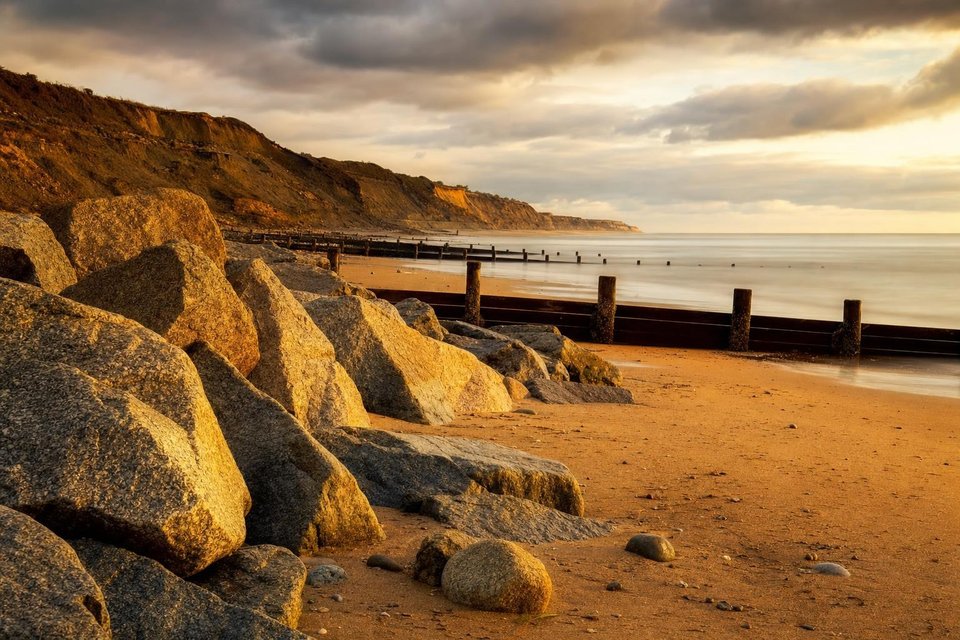
The North Norfolk coast is a long, low line of sand, shingle and soft cliffs facing the North Sea, and it is one of the most rewarding places in England for slow photography. The land is flat, the sky fills most of any frame, and the sea is in constant motion. Long pinhole exposures do something here that a fast shutter cannot: they turn the surf into mist, flatten the wave tops and leave the fixed things behind – the groynes, the reefs, a pier or a lighthouse – standing out with unusual weight.
The stretch covered here runs from the sea defences at Sea Palling, round past Happisburgh and Cromer, and west to the huge beaches at Holkham. It is easy to reach from Norwich by train to Cromer and Sheringham, although the eastern end and the big western beaches are much easier with a car or a bike.
Sea Palling and its reefs
Sea Palling is the place to start, because nothing else on the coast looks like it. The North Sea flood of January 1953 broke through the dunes here, with loss of life in the village, and the defences that followed have shaped the shore ever since. A tall concrete sea wall backs the beach, and from the 1990s a chain of rock reefs was built offshore to take the force out of the waves.
The Sea Palling sea defences are easiest to understand from the top of the wall, where the whole system is laid out at once, and the reefs changed the beach itself. Sand has piled up behind each one, so the shoreline now curves out in a series of scalloped bays. At low tide the reefs sit like dark blocks on the horizon, and the pattern of curves, rock and sea wall makes simple, graphic pictures that suit the softness of a pinhole. From the top of the sea wall a short box gives a wide view down the bays; down on the sand, a camera placed low turns the nearest reef into a heavy shape against a pale smoothed sea.
Do not walk out to the reefs. The rocks are slippery, the channels between them carry strong currents and the tide floods across the flat sand faster than it looks. Everything worth photographing at Sea Palling can be done from the beach and the wall.
Happisburgh and the moving cliff line
A few miles north, Happisburgh shows the other side of the story. The soft cliffs here erode quickly, and over the last few decades houses, a road and the old wooden sea defences have gone over the edge. Broken timber, concrete and fallen clay lie on the beach below, and the cliff face changes from one winter to the next. It is a sobering place and a good subject for slow, honest pictures.
Above the village stands the red and white striped lighthouse, built in 1790 and the oldest working lighthouse in East Anglia. It photographs well from the fields inland, isolated against the sky. In 2013 the shifting beach briefly exposed footprints left by early humans more than 800,000 years ago, the oldest known outside Africa, and they were washed away within weeks. Nothing on this coast stays put for long.
Cromer pier
Cromer is a Victorian seaside town on top of the cliffs, and its pier, opened at the start of the twentieth century, runs straight out into the sea with a theatre and the lifeboat station at its end. Piers are a classic long exposure subject, and this one is ideal for a pinhole camera: from the beach to either side, the legs of the pier march out into water that a few seconds of exposure turns smooth and pale. Shoot it at mid tide so there is water under the whole length, and try a frame from directly underneath, where the girders make a dark tunnel that ends in bright sea.
West of Cromer, the cliffs at West Runton and the beach at Sheringham are quieter, with chalk reefs and rock pools at low tide that look interesting from a camera placed right at the water’s edge.
Holkham and the big beaches
At the western end, Holkham beach is the opposite of Sea Palling: a vast stretch of sand backed by pine woods and dunes, with the sea often a long walk away at low tide. The scale is hard to show with any camera. A pinhole helps by including everything, from the ripples in the sand at the front of the frame to the tree line in the distance, all equally sharp and equally soft. Further along, the beach huts at Wells-next-the-Sea stand on stilts in a long colourful row, and at Hunstanton the striped cliffs face west across the Wash, so the sun sets over the sea, a rare thing on England’s east coast.
Tides, wind and tripods
The coast throws three practical problems at a pinhole photographer, and they are worth solving before the first frame.
- Read the tide. Low tide gives reefs, sand ripples and wet reflections; high tide gives waves against the groynes and the sea wall. A tide table for the nearest port decides the whole day.
- Beat the wind. A tripod in an onshore wind shakes during a twenty second exposure. Keep the legs short, hang a bag from the centre and shield the camera with your body.
- Keep sand out. Fine sand gets into shutters and film gates. Load film in the car or a bag, and close the pinhole cover before moving.
- Choose the time to suit the sea. A fraction of a second freezes waves into soft lumps; ten seconds or more flattens them into mist.
Exposure is where the beach surprises people. Bright sand and sea reflect so much light that a pinhole at around f/192 still gives short times on fast film, too short to smooth the water. Slower film, or paper negatives at a few ISO, stretch the same scene into the range where the sea turns to fog. The figures below assume a bright beach metering 1/250 s at f/22 on ISO 400, scaled for slower media, with no reciprocity correction applied.
| Medium | ISO | Calculated time | What the sea does |
|---|---|---|---|
| Ilford HP5 Plus | 400 | 0.3 s | Waves softened but visible |
| Ilford FP4 Plus | 125 | 1 s | Surf blurs into streaks |
| Paper negative | 6 | 20 s | Sea becomes a smooth sheet |
| Paper negative | 3 | 41 s | Mist, with clouds starting to drag |
Paper times grow quickly in duller light, and film past one second needs a reciprocity correction, which the Zero Image exposure guides cover with dial-based tables. The waterfall page deals with the same question of moving water in the much darker setting of a wooded valley.
Two things worth packing that nobody mentions: a cloth to wipe salt spray off the pinhole cover, and a spare roll. On a day when the cloud keeps changing, the coast gives a different picture every ten minutes from the same spot, and that is a good reason to leave the tripod where it is and keep shooting the same groyne as the tide comes in.
Frequently Asked Questions
What are the reefs off Sea Palling?
They are man-made offshore breakwaters of large rock, built from the 1990s onwards to protect a low stretch of coast that was breached by the North Sea flood of 1953. The reefs slow the waves before they reach the beach, and sand has built up behind them into curved bays. At low tide they stand clear of the water and make strong, simple shapes for a pinhole camera.
Is it safe to walk out to the Sea Palling reefs?
The rocks are slippery, the gaps between reefs carry strong currents and the tide on this coast can come in quickly across flat sand. It is much safer to photograph the reefs from the beach and the sea wall than to walk out to them. Check a tide table for Sea Palling or Cromer before setting off, and stay well clear of cliff edges further along the coast.
When is the best time of year for the Norfolk coast with a pinhole camera?
Autumn and winter suit it well. The beaches are emptier, the sun stays low and rakes across sand and shingle, and the skies are often dramatic. Summer brings long evenings but also crowds and flat midday light. Grey seals pup on Blakeney Point in the winter months, which is a reason to visit that stretch between November and January, viewing from a distance.
Do pinhole cameras need ND filters at the beach?
Usually not. A pinhole at around f/192 is already more than six stops slower than f/22, so a bright beach gives exposures of about a third of a second on ISO 400 film. To smooth the sea further, slower film or paper negatives do the job instead of a filter. Paper at ISO 3 to 6 stretches the same scene to somewhere between twenty and forty seconds.