Places
Instant Film Pinhole Camera on the Road: Toledo, Washington to Coldwater Lake
An instant film pinhole camera on the road from Toledo, Washington to Coldwater Lake below Mount St Helens: film choice, exposure, cold and handling prints.
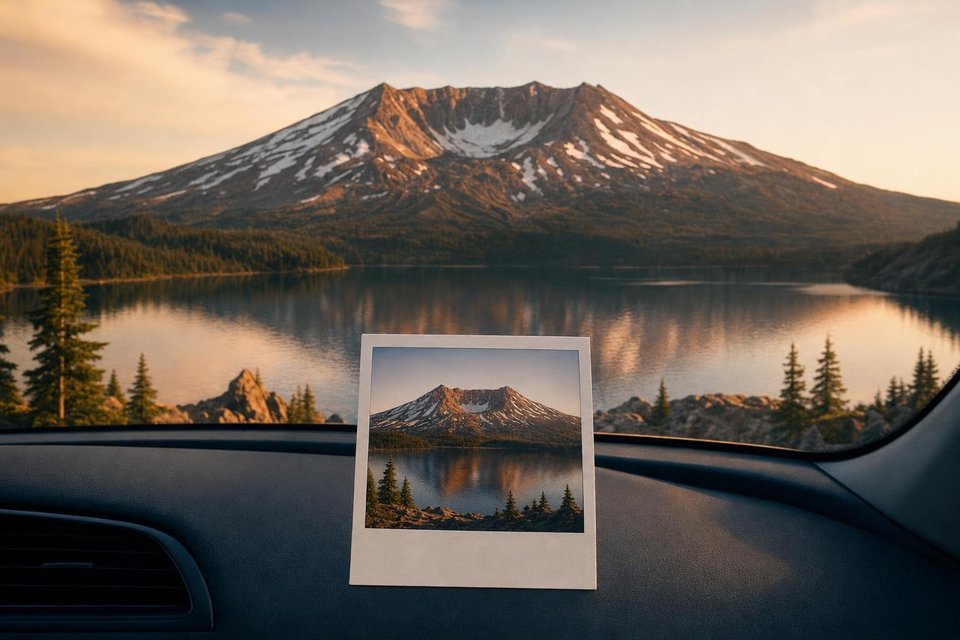
Toledo, Washington is a small town on the Cowlitz River in the south-west of the state, a short drive off the freeway between Seattle and Portland. Most people pass it without stopping. It has a main street, a river with a boat launch, a few churches and a handful of businesses, and a road that leads east out of town into the forested hills towards Mount St Helens. That road, and the lake at the end of it, make an unusual and rewarding outing for an instant film pinhole camera.
Instant film suits a trip like this for a simple reason. A pinhole camera gives no preview and very little control, so the photographer normally waits days or weeks to find out what worked. With an instant pinhole camera the answer arrives a few minutes later on the roadside, which makes it possible to correct the next exposure while the light is still the same.
The road to Coldwater Lake
From the Toledo area, State Route 505 heads south-east through farmland and forest to join the Spirit Lake Memorial Highway, which climbs up the valley of the North Fork Toutle River towards the volcano. The landscape changes on the way. Green dairy country gives way to tree plantations, then to the open, scarred valley left by the eruption of 18 May 1980, when the north face of the mountain collapsed and a vast landslide and blast flattened forests across hundreds of square kilometres.
Coldwater Lake lies near the end of the road. It did not exist before 1980: the debris from the eruption blocked Coldwater Creek, and the lake formed behind the new dam of rubble. Today it is a long, clear lake surrounded by slopes still recovering from the blast, inside the Mount St Helens National Volcanic Monument. Grey stumps, fallen logs and new growth line the shore, and on a clear day the mountain itself shows above the valley.
For a pinhole camera, this is a landscape of textures rather than details: bleached timber, pale ash slopes, still water and dark new forest. The softness of a lensless image suits it, and the square or slightly oblong shape of instant prints frames the lake and the mountain well.
Choosing instant film for a pinhole camera
Instant pinhole cameras are built around one specific film format, so the choice of camera is also the choice of film. Two families dominate today. Fujifilm Instax comes in three sizes, all at ISO 800. Polaroid makes integral film for its 600, i-Type and SX-70 systems, with a larger square image. The table compares the image areas and speeds.
| Film | Image area | ISO |
|---|---|---|
| Instax Mini | 62 × 46 mm | 800 |
| Instax Square | 62 × 62 mm | 800 |
| Instax Wide | 99 × 62 mm | 800 |
| Polaroid 600 and i-Type | about 79 × 79 mm | about 640 |
| Polaroid SX-70 | about 79 × 79 mm | about 160 |
Instax gives sharper, more predictable colour and is easier to find. Polaroid film has a dreamier palette and stronger reactions to temperature, which many pinhole photographers enjoy for exactly that reason. Fujifilm’s peel-apart films, which some older pinhole backs were designed for, ended around 2016. More on one dedicated instant camera is in the first shots with a Supersense camera.
Exposure on instant film
The arithmetic is the same as for any pinhole camera. Meter at f/22 for the film speed, then multiply by the square of the pinhole f-number divided by 22. At f/192 that factor is about 76. The table works through typical scenes on the road for ISO 800 film, before any extra time for reciprocity.
| Scene | Reading at f/22 | Calculated time |
|---|---|---|
| Bright sun on pale ash and water | 1/400 s | 0.2 s |
| Overcast lake shore | 1/100 s | 0.8 s |
| Forest edge in shade | 1/30 s | 2.5 s |
| Inside a roadside bar | 1/4 s | 19 s |
Instant film manufacturers publish little reciprocity data, and the films behave differently from black and white negative stock. The practical approach is to bracket on the first pack: one frame at the calculated time, one at about half again, and keep notes. After a few packs a personal correction emerges. The pinhole camera guide covers the f-number and diameter side in more depth.
Composing for a small print
An instant print is small, and a pinhole image is soft, so the two together reward simple compositions. A single strong shape works best: one dead tree against the lake, the line of the shore, the cone of the mountain against the sky. Busy scenes with lots of small detail turn to mush at print size, even when the same view would look fine on a large negative.
Distance matters less than with a lens, because everything from a few centimetres to the horizon is equally in focus. That opens up a trick that suits this landscape well. Put the camera on the ground close to a stump or a rock on the lake shore, so it fills the lower half of the frame, and let the water and the mountain sit small behind it. The near object gives the print weight, and the soft distant view gives it depth. With a pinhole camera on instant film the result can be checked on the spot, and a second frame moved a hand’s width to the side often makes all the difference.
Handling the prints on the road
- Shield the print. Polaroid film in particular needs to develop away from light for the first minutes; a dark pocket or a box works.
- Keep it warm. On a cold lake shore, tuck the print inside a jacket while it develops, or it may come out pale.
- Do not shake it. The old habit does nothing useful and can mark the image.
- Write on the back. Note the place, the time and the exposure with a soft pencil before the details blur.
Temperature is the hidden variable on a trip like this. A summer morning at Coldwater Lake can be cool at the water and hot by noon, and the same exposure gives noticeably different prints. Carrying the film pack and camera in a bag rather than on a sunny dashboard keeps results more even.
A short note on Toledo itself
Small towns along a road trip are often more interesting through a pinhole than the famous stops. Main streets, painted signs, old cars and church fronts sit still for long exposures and rarely draw a crowd.
Toledo sits on the Cowlitz River, and the riverbank, the main street and the signs along the road out of town all make quiet, odd subjects. Portland, Oregon, under two hours south along the same freeway, is the nearest large city, and the road through Toledo is a natural detour for anyone travelling up from there, perhaps on a Worldwide Pinhole Photography Day outing. Instant prints of roads, lakes and mountains sit well alongside the other slow pictures in the gallery.
Frequently Asked Questions
Which instant film works best in a pinhole camera?
It depends on the camera's film back. Fujifilm Instax films are rated at ISO 800 and are the most widely available, which keeps pinhole exposures short. Polaroid 600 and i-Type films are rated at around ISO 640 and give a larger square print with a softer, more unpredictable palette. Whichever is used, the camera has to be designed for that exact format, because instant film packs are not interchangeable.
How long is a pinhole exposure on instant film?
At around f/192 and ISO 800, bright sun usually needs a fraction of a second, an overcast day close to a second, and open shade a few seconds. Indoors, times run to twenty seconds or more. Instant films have little published reciprocity data, so most pinhole users bracket generously on their first pack and keep notes to build their own correction.
Why do instant pinhole pictures come out pale in the cold?
The developing chemistry in instant film works more slowly when it is cold, so prints made on a chilly morning often turn out light, flat or with a colour cast. Keeping the camera or the ejected print warm inside a jacket while it develops helps a great deal. In very hot weather the opposite can happen, with darker, warmer prints than expected.
Is peel-apart instant film still made?
Fujifilm ended its peel-apart films, the black and white FP-3000B around 2014 and the colour FP-100C in 2016, and no major manufacturer has replaced them. Old packs still turn up, but they are long expired and results vary. Most instant pinhole photography today uses integral film from Instax or Polaroid, where the print develops on its own after leaving the camera.