Camera
Ondu Pinhole Camera Review: First Impressions of the Wood, Magnets and Lumu
An Ondu pinhole camera review: the magnetic wooden body, 135 panoramic blinds, winding and shutter habits, plus first impressions of the Lumu light meter.
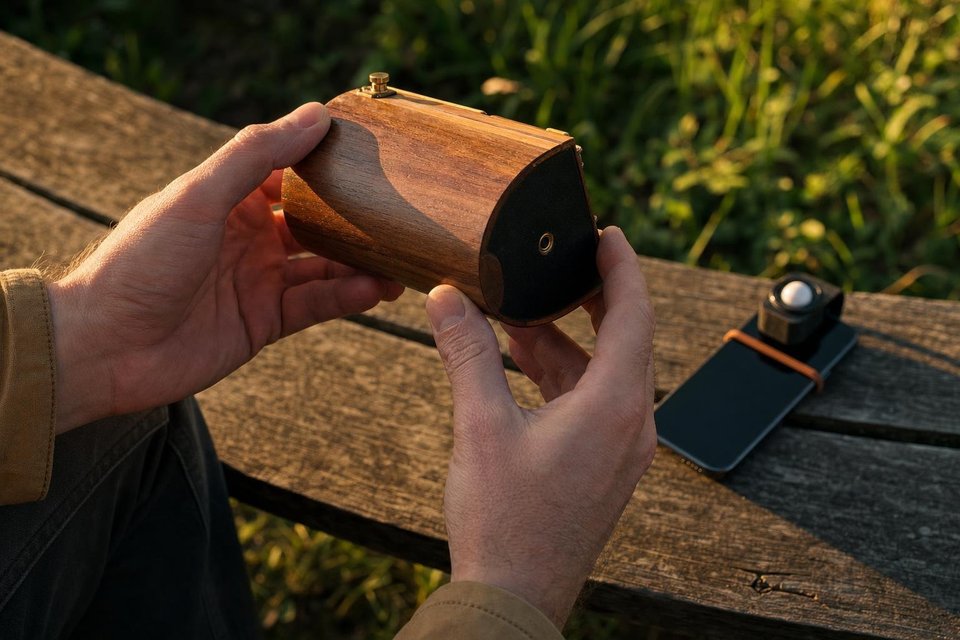
There is something faintly absurd about a camera with no lens, no viewfinder and no electronics becoming one of the most talked-about crowdfunding projects of its year. Ondu managed it, twice, with wooden pinhole cameras made in Slovenia, and the attraction is obvious the moment one comes out of the box. It is a small, warm, carefully finished object that happens to take pictures.
This Ondu pinhole camera review looks at the 135 panoramic model in practical use, through loading, metering, shooting and winding on a first roll. The second half turns to the Lumu, a small light meter for phones that came out of the same wave of crowdfunded photographic gadgets, and to the wider question of using a phone as a pinhole meter.
First Impressions of the Ondu 135 Panoramic
The body is wood, and the parts are held together by magnets rather than screws or clips. The back pulls off and snaps on again, the winding knobs drop into place and stay there, and the shutter is kept closed by a smaller magnet of its own. The idea sounds fragile and turns out not to be. Construction is precise enough that the pieces align without fuss, and the magnets are strong enough that a camera carried in a jacket pocket stays shut.
A reusable 35 mm cassette comes with the camera, and loading follows the routine of any bulk-loading photographer: tape the film to the spool, wind it in, close the cassette. Ondu supplies clear instructions for the whole process. With the cassette and take-up spool in place, the knobs go on, the back goes on, and the camera is ready.
Inside the film chamber sit two small wooden blinds. With them in place the camera exposes the standard 24×36 mm frame. Taken out, the full width of the chamber is used and the frame becomes 24×72 mm, a true panorama twice the width of a normal negative. The pinhole works at f/125, a figure the maker confirmed for early units.
These first impressions are mostly about how pleasant the camera is to handle. It is light, it has no sharp corners, and it draws people into conversation in a way a modern digital camera rarely does.
Handling, Shutter and Winding
Shooting is simple. Meter the scene, slide the shutter open, count, slide it shut. With negative film’s latitude, rough metering would often be good enough, but the best negatives from a first roll tend to come from frames that were metered carefully.
There is no cable release, and that is the camera’s most noticeable limitation. On exposures of several seconds or more it hardly matters, since the brief movement of opening and closing makes up a tiny share of the total. On short daylight exposures of a quarter or half a second it shows, as a faint doubling or general softness that has nothing to do with the pinhole. A tripod helps, but even on a tripod a finger can nudge the box.
The classic workaround is older than the camera. Hold a dark card or a hat in front of the pinhole, open the shutter behind it, then lift the card away for the exposure and drop it back before closing the shutter. The card becomes the real shutter, and it never touches the camera.
Mark the winding knob with a strip of tape so each half turn can be counted, and draw an arrow on it to show the direction. Winding the wrong way usually does no harm, but losing count does.
Winding is done by turns of the knob, with recommendations from Ondu for the standard and panoramic frames. Those figures are a starting point. Film thickens on the take-up spool as the roll progresses, so a fixed number of turns produces gaps that shrink or grow through the roll, and a little experience lets the photographer adjust. A home-made clicker that counts sprocket holes is the frugal solution for anyone who hates wasting film.
Things to Watch on the First Roll
Three habits make a large difference to the first few films, and all of them come from the design rather than from any fault in it.
- Check the blinds before loading. Shooting a whole roll wound for panoramic frames with the blinds still in leaves a strip of blank film between every picture.
- Find a safe place for the blinds when they are out of the camera. They are small, light and easy to lose in a bag.
- Keep the camera in a pouch or a case. A small magnet holds the shutter, and a camera rattling loose in a bag can open by accident.
- Steady short exposures with a support, a wall or the dark-card method described above.
None of these is a reason to avoid the camera. They are the small adjustments any camera without a viewfinder or lever asks for, and they become automatic after a roll or two.
Ondu Pinhole Camera Review: Formats and the Wider Range
The 135 panoramic is only one member of a family. Over the years the Ondu range has included a compact 35 mm pocket model, medium format cameras for 6×6 and 6×12 frames on 120 roll film, and a 4×5 inch body for sheet film. The construction principle stays the same throughout: wood, magnets and a sliding shutter.
| Format | Frame size | Frames per load | Shape |
|---|---|---|---|
| 35 mm standard | 24×36 mm | up to 36 | 3:2 |
| 35 mm panoramic | 24×72 mm | about half a roll's count | 3:1 |
| 120 square | 6×6 cm | 12 | 1:1 |
| 120 panoramic | 6×12 cm | 6 | 2:1 |
| Sheet film | 4×5 inch | 1 per sheet | 5:4 |
The panoramic formats reward a particular way of seeing. Wide pinhole frames exaggerate the curve of anything close to the camera, and a pavement or a bench in the foreground can sweep across the bottom of the picture in a way no lens camera would show. Streets work well, and so do river banks and coastlines. A walk through a compact city such as Norwich, sketched in a pinholista’s guide to Norwich, gives plenty of material for a first panoramic roll.
Against its main rivals, the Ondu pinhole camera sits between the heavier Zero Image bodies and lighter cardboard or plastic designs. Several Zero Image cameras accept a cable release, which the Ondu lacks. The Ondu wins on size, weight and sheer charm. Readers comparing small 35 mm models may also want to look at the Miru 35 mm camera.
The Ondu does one thing, does it well and looks lovely doing it. Its only real weakness is the lack of a cable release on short exposures.
For anyone looking for a compact, well-built pinhole camera to carry every day, the Ondu is easy to recommend. Its verdict in this Ondu pinhole camera review comes down to that: buy it for the pleasure of using it, and plan for steady support on bright days.
The Lumu Light Meter
The Lumu came from the same period and the same funding route. It is a small incident light meter that plugged into a phone’s headphone socket and worked with its own apps, one general and one designed for pinhole cameras. It was small enough to hang on a cord round the neck or to drop into a pocket next to the phone.
Incident metering means the meter reads the light falling on the subject rather than the light bouncing off it. The photographer stands where the subject is, or in the same light, and points the meter back towards the camera. For pinhole work this is often more reliable than a reflected reading, because a pinhole picture covers such a wide angle that a reflected meter averages a mixture of sky, shadow and foreground.
- Set the app. Enter the pinhole f-number, f/125 for the 135 panoramic, and the film speed, such as ISO 100 for a slow colour negative film.
- Turn the volume up. The meter drew its signal through the audio socket, and the app asked for full volume before it would read.
- Read the light. Point the dome back towards the camera position and tap the screen. The meter swivels so the screen stays visible.
- Correct for film. Apply the maker's reciprocity correction to any time over a second before opening the shutter.
Two practical points stand out. A phone in silent mode could stop the meter from being detected at all, which looks like a fault until the switch is found. And the early pinhole app, at least, did not include reciprocity data for film, so the correction had to be worked out separately, which also meant giving up the app’s built-in timer and its handy log of each exposure. In daily use the meter proved about as quick as a dedicated hand-held meter once the app was open, and faster still if the phone stayed unlocked between frames.
Exposure Numbers at f/125
At f/125 the pinhole needs about 32 times the exposure of a lens set to f/22, a shade over five stops. That makes the 135 panoramic one of the faster pinhole cameras around, and on a bright day with ISO 400 film it leaves very little time to count. Slow film is the easier match: a colour negative film rated at ISO 100 turns a sunny street into exposures of around half a second and a shaded one into a few seconds, long enough to open and close the shutter calmly.
| Meter at f/22 | Time at f/125 | HP5 Plus corrected |
|---|---|---|
| 1/125 s | 0.3 s | 0.3 s |
| 1/60 s | 0.5 s | 0.5 s |
| 1/30 s | 1.1 s | 1.1 s |
| 1/15 s | 2.2 s | 2.7 s |
| 1/8 s | 4.0 s | 6.2 s |
| 1/4 s | 8.1 s | 15 s |
| 1/2 s | 16 s | 38 s |
The table also shows where the lack of a cable release bites. Everything down to the 1/30 s row lasts about a second or less, which is exactly where opening the shutter by hand is most likely to shake the picture. Below that, the exposures are long enough for the hand movement to vanish into the total. Overcast days and late afternoons therefore suit the camera better than midday sun, a pleasant reversal of the usual photographic advice.
Crowdfunding as a Route to New Cameras
Both products came out of crowdfunding campaigns that ran far beyond their targets. That kind of success brings its own problems: a small maker suddenly has to build many times the planned number of units, and delivery dates slip. Backers who expect patience and accept some risk tend to be happy; those who expect a shop’s delivery dates often are not.
The model has kept giving pinhole photography new cameras ever since, from wooden bodies to cardboard kits and printed designs. Anyone backing one should read the maker’s track record and plans carefully. For exposure itself, a printed card like the ones described in the Zero Image exposure guides works with any of them, including the Ondu.

Frequently Asked Questions
Is an Ondu camera a good first pinhole camera?
It is an easy one to live with. Loading is ordinary 35 mm or 120 practice, the shutter is simple and the build quality removes most of the light-leak worries of a home-made box. The main things to learn are the winding count and steadying the camera on short exposures. A cardboard kit costs far less, but the Ondu is likely to be carried more often.
Does the Ondu 135 panoramic take two formats on one roll?
It can, because the blinds are removed or inserted inside the camera, but switching mid-roll means opening the back, which is best done in shade or a changing bag. Most users settle on one format per roll and write it on the cassette. Mixing them also complicates the winding count, since the panoramic frame needs about twice the advance of the standard one.
Can the Lumu meter still be used today?
The original Lumu plugged into a phone's headphone socket, which many recent phones no longer have, so it needs an older handset or an adapter that passes the right signal. A later version moved to a different connector. Any meter that reads incident light will do the same job for pinhole work, combined with a card or an app that applies the pinhole factor.
What f-number does the Ondu 135 panoramic use?
The 135 panoramic model works at f/125, a figure confirmed by the maker for early units. Other Ondu cameras use different focal lengths and therefore different f-numbers, which are normally printed in the instructions or on the body. At f/125 the exposure is about 32 times the reading at f/22, so a reading of 1/125 s becomes roughly a quarter of a second.