Places
Waterfalls in Derbyshire and Beyond with a Pinhole: Lumsdale to Reekie Linn
Photographing Lumsdale Falls, Kinder Downfall, Reekie Linn and Ashgill Force with a pinhole camera: long exposures of water, safety, access and timing.
Falling water and a pinhole camera are made for each other. The long exposures that a tiny hole forces on the photographer, usually a few seconds and often much more in a shady valley, are exactly what turns a waterfall into the smooth, milky ribbon that photographers with lenses need filters and planning to achieve. Add the soft focus and the natural fall-off of light towards the edges of a pinhole frame, and wet rock, moss and ruined stonework start to look like something out of a nineteenth-century print.
Derbyshire is a good place to start, with dozens of small falls in the gritstone and limestone valleys of the Peak District. This page covers a handful of favourites there and two further north, in Cumbria and in Angus, with notes on exposure, access and keeping both feet dry.
Lumsdale Falls, Matlock
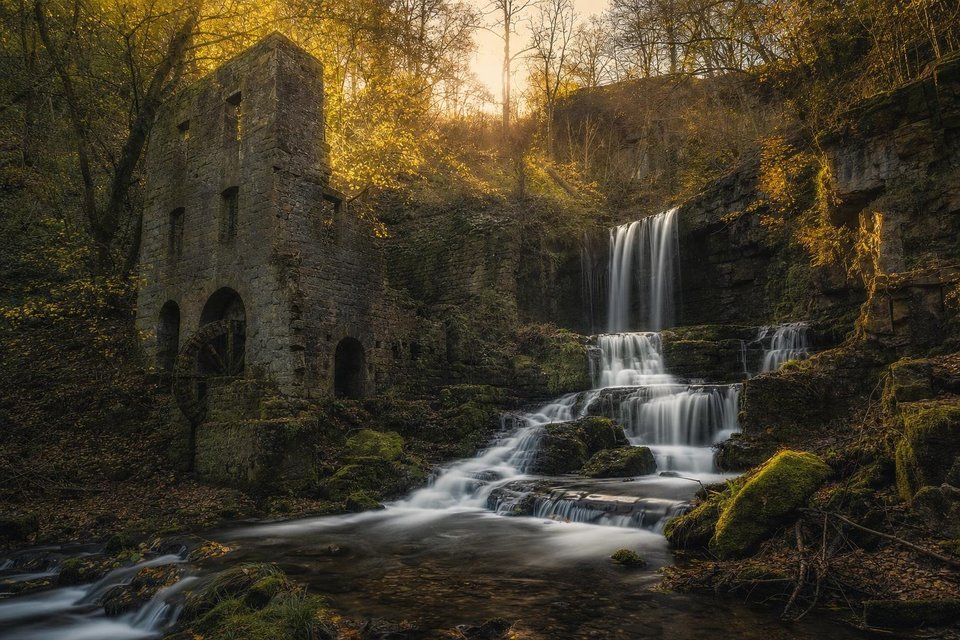
Lumsdale is a short, steep valley on the eastern edge of Matlock, and for anyone interested in waterfalls in Derbyshire it is the first stop. Bentley Brook drops through a chain of mill ponds and cascades, and the valley sides are lined with the ruined walls of water-powered mills that once used the stream for grinding, bleaching and other trades from the seventeenth to the nineteenth centuries. The ruins are cared for by a local heritage trust, and they are now half swallowed by trees, moss and ferns.
The main Lumsdale waterfall runs down a series of rock steps right beside one of the mill buildings, so a single frame can hold stone walls, empty window openings and white water together. That combination is what draws photographers, and on a bright weekend the narrow paths fill up. A weekday morning or a wet, grey day gives the valley back to its streams, and grey days are better for the pictures in any case, with no bright patches of sky breaking through the canopy.
Lumsdale is reached on foot along narrow paths with steep drops, and the rocks around the falls are slippery all year. Parking nearby is very limited and the lanes are residential, so walking in from Matlock is the considerate option.
Lumsdale falls are at their best after a few days of rain, when the brook spreads across the full width of the rock steps. In a dry summer they can shrink to a trickle, which still makes a fine close-up but loses the drama of the full cascade.
More waterfalls in Derbyshire
Kinder Downfall is the opposite of Lumsdale: high, exposed and wild. It is the tallest waterfall in the Peak District, dropping about 30 metres off the western edge of the Kinder Scout plateau, and it is reached only by a long walk up onto the moor, partly along the Pennine Way. In strong westerly winds the water is blown back up over the edge in a plume of spray. In hard winters the fall freezes into columns of ice.
Padley Gorge, near Grindleford, is gentler. Burbage Brook tumbles through old oak woodland in a long string of small falls and pools, and the mossy boulders and twisted trees suit the soft look of a pinhole image. Three Shires Head, where Cheshire, Derbyshire and Staffordshire meet, combines a small fall on the River Dane with an old packhorse bridge, a classic composition that works at any scale.
Reekie Linn, Angus
Further north, the River Isla cuts through a deep wooded gorge north of Alyth in Angus and drops over Reekie Linn, one of the most impressive falls in Scotland. The name is Scots: reekie means smoky and linn means a waterfall, and the smoke is the spray that rises out of the gorge when the river is running high. The falls drop in two stages over a total height of roughly twenty metres or more, and in flood the two merge into one roaring sheet.
Reekie Linn falls are seen from paths along the top of the gorge, with fenced viewpoints above sheer drops. The view down into the spray suits a long exposure: the water goes white and soft, while the dark rock walls around it stay solid. Cold, still mornings after heavy rain are the time to go, when the spray hangs in the gorge and catches whatever light comes in.
Ashgill Force, Cumbria
Ashgill Force sits in a side valley of the South Tyne near Garrigill, in the remote North Pennines. A beck drops over a ledge of rock into a small amphitheatre, and the overhang is deep enough to walk behind the fall. Looking out through the curtain of water is one of the most unusual views any waterfall in England offers, and a pinhole camera placed on the dry ledge behind it records the falling water as a pale veil with the green valley beyond.
Timing matters more for waterfalls than for almost any other subject. Late autumn is hard to beat: the rivers are full, the leaves turn and fall onto the rocks, and the low sun rarely reaches the bottom of a wooded valley, so the light stays even all day. Winter brings ice and the chance of a frozen Kinder Downfall, but also short days and treacherous paths. High summer is the weakest season, with thin water, dense shade and bright gaps in the canopy. The same flowing-water logic applies to the sea, and the North Norfolk coast shows how long exposures change waves rather than falls. More finished pictures of slow water sit in the gallery.
Exposure for moving water
Woodland is dark, and that works in a pinhole camera’s favour. The diagram shows roughly how water changes with exposure time, and the table below turns typical woodland meter readings into pinhole times at f/192.
| Setting | Reading at f/22 | Calculated time | On HP5 Plus (P = 1.31) |
|---|---|---|---|
| Open valley, overcast | 1/30 s | 2.5 s | 3.4 s |
| Light woodland | 1/15 s | 5.1 s | 8.4 s |
| Deep woodland | 1/8 s | 9.5 s | 19 s |
| Shaded gorge | 1/2 s | 38 s | about 2 min |
Almost every waterfall in a wooded valley lands in the silky range without any extra filter. The one thing to watch is the sky: a bright patch of white between the trees will burn out completely during a long exposure, so frame it out where possible. The pinhole camera guide explains where the f/192 figure comes from, and the Zero Image exposure guides give dial-based tables for longer times.
Staying safe by the water
- Treat all wet rock as ice, especially green or dark patches.
- Never set up above a drop or on a ledge with no easy way back.
- Rivers can rise quickly after rain upstream, even on a dry day.
- Keep the camera strap round the wrist when leaning over water.
Spray is the last practical problem. Close to a big fall, fine droplets settle on the front of the camera during a long exposure, and a single drop over the pinhole spoils the frame. A lens cloth, a shower cap or a hand held over the camera between exposures solves it. Ashgill Force is the hardest of these falls to keep dry, and the ledge behind it is the one place where an umbrella earns its weight.
Frequently Asked Questions
Where is Lumsdale Falls?
Lumsdale lies in a small wooded valley on the eastern edge of Matlock in Derbyshire. Bentley Brook drops through a chain of mill ponds and falls, past the ruins of water-powered mills that worked there from the seventeenth to the nineteenth centuries. The site is reached on foot along narrow paths, and parking nearby is very limited, so arriving early or on a weekday makes a visit much calmer.
How long should a waterfall exposure be with a pinhole camera?
Around half a second already softens moving water, two to ten seconds turns it into the familiar silky ribbon, and a minute or more removes almost all texture so the fall becomes a pale glow. In woodland a pinhole camera at about f/192 usually lands in the middle of that range without any filter, which is one reason pinhole and waterfalls work so well together.
Why does Kinder Downfall sometimes flow upwards?
The fall drops off the western edge of the Kinder Scout plateau, and strong westerly winds blow straight into it. In a gale the water is caught by the wind and thrown back up over the edge as a plume of spray, which can be seen from miles away. It makes a striking picture, but it also means the plateau edge is no place for a tripod on those days.
What does the name Reekie Linn mean?
In Scots, reekie means smoky and linn means a waterfall or the pool beneath it. The name describes the cloud of spray that rises from the gorge of the River Isla in Angus when the river is high. On a cold morning that spray hangs in the gorge and catches the light, which suits a long pinhole exposure very well.
Is it safe to set up a tripod in a stream?
Only in shallow, slow water on a firm bed, and never above a drop. Wet rock covered in moss or algae is extremely slippery, and rivers that feed waterfalls can rise quickly after rain upstream. A stable spot on the bank usually gives a better composition anyway, and a short pinhole camera close to the ground can make a small cascade look far larger than it is.