Norwich Photography Walk: A Pinhole Route from Cow Tower to Carrow Hill
A pinhole walk through Norwich: the castle, the cathedral close, the River Wensum, Cow Tower, the city walls at Carrow Hill and where the light works best.
Pinholista editorial team ·
Norwich packs an unusual amount of medieval stone, flint and brick into a small walkable centre, and almost all of it sits low against a slow river. That combination suits a pinhole camera well. Nothing moves quickly, the buildings are big enough to read at a wide angle, and the water of the Wensum gives the long exposures something soft to set against all that hard texture. The county town of Norfolk was for centuries one of the largest and richest cities in England, and the evidence is still standing on almost every corner.
This guide follows a loop of roughly a day on foot, starting at the castle and ending at The Forum, with a detour to the city walls at Carrow Hill. It sticks to things that will still be there in twenty years: buildings, river banks, gardens and the way the light falls on them. Cafés, pubs and shops in the centre change too often to list with any confidence, and the city has more than enough of them to find one when the tripod legs need a rest.
The route at a glance
The loop is short in distance and long in stops. A rough order that keeps the light sensible on a clear day is to start on the castle mound in the morning, reach the cathedral close before midday, take the river in the afternoon and finish on the market and The Forum as the shops close.
A day's pinhole loop through central Norwich
Stop
What to shoot
Best light
Norwich Castle
The Norman keep from the mound and from the market below
Morning, sun on the south and east faces
Tombland and the cathedral close
The Erpingham and Ethelbert gates, the spire, the cloister
Late morning, cloister any time
Pull's Ferry
The flint water gate across the river
Afternoon, from the far bank
Bishop Bridge and Cow Tower
Stone arches, brick tower, willows on the bend
Late afternoon into dusk
Elm Hill and the Lanes
Cobbles, timber frames, narrow views
Overcast days, or low winter sun
St Giles and the Plantation Garden
Victorian Gothic fountain, terraces, quarry walls
Bright overcast
City Hall, the market and The Forum
Bronze lions, striped stall roofs, glass and reflections
Evening
Castle and cathedral
The castle is the obvious first frame. It sits on a huge artificial mound raised by the Normans soon after the Conquest, and the stone keep on top dates from the early twelfth century, although much of its outer skin was refaced in the nineteenth. It served as the county gaol for centuries before it became a museum, and the battlements and dungeons can be visited. Exposure times in the dungeons would be heroic, so the mound itself is the better subject. From the bottom of the market, with a short box held low, the keep stands up like a block on a plinth and the soft edges of a pinhole image make the stone look older still.
A short walk downhill through Tombland leads to the gates of the cathedral close. The cathedral was begun in 1096, and its spire, at around 96 metres, is the second tallest in England after Salisbury. It is worth taking the spire from several distances: close up from the lawn, the converging lines exaggerate its height; from the river meadows it sits calmly over the trees.
The cloister
The cloister is one of the largest of any English monastery, and it is a gift for slow photography. The light comes in sideways through the arcades and bounces off pale stone, so even a dull day gives an even glow without hard shadows. Look up, too. The vaults carry more than a thousand carved and painted roof bosses telling Bible stories, with the odd green man hiding among the foliage. A pinhole camera pointed straight up, braced on a bench, renders a run of vault ribs as soft curving lines that no lens quite matches.
Inside buildings
Indoors the light falls fast. A reading of 1/4 s at f/22 in the cloister turns into about 19 seconds at f/192, and on Ilford HP5 Plus the reciprocity correction stretches that to around 47 seconds. Carry something to sit the camera on, and ask before setting up a tripod anywhere inside the cathedral itself.
Down to the Wensum
From the close a path leads down to Pull’s Ferry, a fifteenth-century flint water gate on the River Wensum. A short canal once ran from here to the cathedral, and it was used to bring stone up from the river during the building works. The gate is best seen from the opposite bank, where the arch, the cottage beside it and their reflection make a neat symmetrical frame. Cross at Bishop Bridge to get there. The bridge dates from around 1340 and is one of the oldest in England still in daily use, with three stone arches that sit nicely at water level.
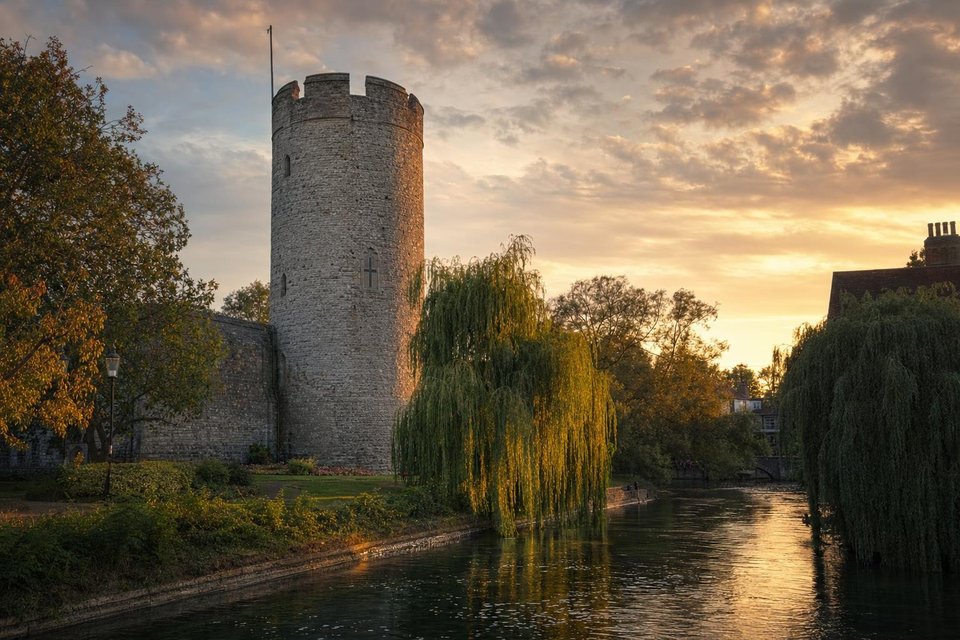
From Bishop Bridge, either bank leads round the river bend to Cow Tower. It was built at the end of the fourteenth century as an artillery tower guarding a loop of the river, and it is one of the earliest buildings in England made largely of brick. It stands alone in a meadow among willows, and on a still afternoon its reflection lies whole in the water. This is the spot most worth returning to: the tower changes completely with the season, the height of the river and the angle of the sun.
1096Norwich Cathedral begun
c. 1340Bishop Bridge built over the Wensum
1390sCow Tower raised in brick on the river bend
Water is the reason to bring a pinhole camera here rather than anything faster. Exposures of several seconds smooth out ripples and wind on the surface, so the river becomes a pale sheet that holds the reflection of the tower, the trees and the sky. On a breezy day the willows blur into a soft mass while the brick stays solid, which is a contrast that tends to work in black and white.
The walls and Carrow Hill
Norwich was once ringed by one of the longest town walls in England, built in the late thirteenth and early fourteenth centuries, and long sections still survive. They turn up in odd places, beside a car park or at the back of a terrace, which makes them good subjects in themselves: medieval flint next to modern concrete reads well when everything is equally soft.
The most rewarding stretch is on Carrow Hill, south-east of the centre and a short detour from the main loop. Here the wall climbs the hill with its towers, including the Black Tower at the top, and the slope lets a pinhole camera look along the line of the wall rather than straight at it. Down by the river at the foot of the hill, the remains of the boom towers once held a chain across the Wensum to control river traffic.
Medieval flint beside modern concrete reads well when everything in the frame is equally soft.
Elm Hill, the Lanes and St Giles
Back on the main loop, the river path leads to Magdalen Street and then up Elm Hill, the city’s best known cobbled street. Much of it was rebuilt after a great fire in the early sixteenth century, and the timber-framed houses lean together in a way that suits the wide view of a short pinhole box. The cobbles are worth a frame of their own with the camera placed right on the ground, where the nearest stones and the far end of the street come out equally sharp.
From Elm Hill, St Benedict’s Street runs west, and at any point the Norwich Lanes climb uphill towards the centre. The Lanes are narrow and full of small independent shops, so they are busy in the middle of the day. Long exposures turn passers-by into faint smears or remove them altogether, which is one of the quiet pleasures of pinhole work in a crowded street.
Place the camera on a bin, a wall or a step and let people walk through the frame.
Exposures over ten seconds usually lose anyone who keeps moving.
Seated people stay, standing people ghost, cyclists vanish.
At the end of St Benedict’s, Grapes Hill leads up to Upper St Giles, and a footbridge crosses the ring road to the Roman Catholic Cathedral of St John the Baptist. It was built as a parish church at the turn of the twentieth century and became a cathedral in 1976. Behind it lies the Plantation Garden, a Victorian garden laid out from the 1850s in a former chalk quarry, with terraces, an Italianate stretch and a Gothic fountain at its centre. It is enclosed, sheltered and full of texture, and a tripod can usually be set up in peace. The quarry walls throw shade early and late, so the middle of a bright overcast day is when the whole garden lights up evenly.
City Hall, the market and The Forum
From St Giles the route turns back towards the centre past the Guildhall and in front of City Hall, a long brick building from the 1930s with a tall clock tower and two bronze lions guarding the steps. The lions are an easy subject at any time, and the steps give a stable place to rest a camera.
Below them lies Norwich Market, one of the largest open-air markets in England, with rows of stalls under striped canopies. From the top edge there is a clean view across the stall roofs to the castle on its mound, which neatly closes the loop. The striped roofs come out as soft bands of grey on black and white film and as a patchwork on colour.
St Peter Mancroft, a fifteenth-century church with a tall tower, stands beside The Forum, a glass building opened in 2001 that houses the city library. The pairing of medieval stone and a curved glass front is a classic double exposure: one frame of the church, wind on only partly or not at all, then the glass. Pinhole cameras without a double-exposure lock make this easy, and the softness hides the seam.
Along the loop
Nine centuries in one afternoon
The walk passes buildings from almost every century since the Normans.
AI
Early 1100sCastle keepNorman stone keep on its artificial mound above the market.
AI
1400sSt Peter MancroftA large town church beside the market, with a tall tower.
AI
1500sElm HillTimber-framed houses rebuilt after a great fire.
AI
1930sCity HallBrick civic building with a clock tower and bronze lions.
AI
2001The ForumGlass-fronted library facing the old church.
Light, weather and exposure
Norfolk is flat and the sky is big, and in the city that means the light changes quickly as clouds move in from the North Sea. Overcast days are common and not a problem: flint and brick look good in soft light, and the narrow streets would otherwise sit half in deep shadow. Low winter sun is the other gift, raking across flint walls and picking out every stone.
For a 50 mm box at around f/192, a bright overcast reading of 1/125 s at f/22 becomes roughly 0.6 seconds, short enough to hand-hold on a wall. Under trees by the river at 1/15 s, the same box needs about five seconds, or around eight on HP5 Plus once reciprocity is added. The exposure tables for Zero Image cameras and the pinhole camera guide explain the arithmetic in full.
Galleries and film
The Castle Museum holds a fine collection of the Norwich School of painters, among them John Crome and John Sell Cotman, whose river scenes are worth seeing before walking the same banks. Photography exhibitions there are occasional. The Sainsbury Centre, in Norman Foster’s hangar-like building on the University of East Anglia campus, shows a wide collection and stages photography from time to time, and the Norwich University of the Arts has a public gallery and degree shows that include photography.
For film and kit, a large photographic retailer is based in the city, and it is often said to be one of the biggest in the country. Smaller second-hand camera shops have come and gone in the centre over the years, so it is safest to bring enough film for the trip. Processing at a high standard usually means posting film to a specialist lab rather than using a local counter.
Out of town
Cromer and Sheringham by the Bittern Line for piers, cliffs and groynes.
Wroxham for boats, reeds and the edge of the Broads.
The Bure Valley Railway to Aylsham for windmills and flat marsh.
Norwich is the starting point for two very different landscapes. The Bittern Line runs north to Cromer and Sheringham, where the North Norfolk coast offers piers, beaches and groynes within an hour or so of the city. Inland, trains reach Wroxham, the gateway to the Broads, a network of rivers and shallow lakes protected with the status of a national park. From Wroxham the narrow gauge Bure Valley Railway runs about nine miles to Aylsham, and getting off part way puts reed beds, windmills and long flat horizons within walking distance.
The Broads are perhaps the best setting in the county for very long exposures, because almost nothing in the landscape is taller than a windmill and the sky takes up most of the frame. A pinhole camera on a post by the water, left open for a minute while clouds drift past, records a view that the eye never quite sees. For more of that kind of picture, the gallery collects places where slow light does most of the work.
A last note for the city itself: the bends of the Wensum around Cow Tower flood after heavy rain, and the river meadows can be soft underfoot for days afterwards. The view of the tower across standing water is one of the best in Norwich, but boots matter more than any camera on those mornings.
FAQ
Frequently Asked Questions
How long does the Norwich walk take with a pinhole camera?
The loop from the castle through the cathedral close, along the Wensum to Cow Tower, up Elm Hill and round by St Giles is only a few kilometres. On foot without a camera it fills a morning. With a tripod and exposures of several seconds at every stop, most people need a full day, and the riverside section alone can easily take two hours if the light is good.
Can a tripod be used inside Norwich Cathedral?
Rules for tripods inside cathedrals change and are set by the cathedral itself, so it is sensible to ask at the welcome desk before setting one up. The cloister is often the easier place to work, and a small pinhole camera braced on a ledge or a beanbag can do without a tripod entirely for exposures of a few seconds.
What is the oldest part of the walk?
The castle keep and the cathedral are both Norman. The cathedral was begun in 1096 and the castle keep dates from the early twelfth century. Bishop Bridge, from around 1340, is among the oldest bridges in England still carrying traffic, and Cow Tower followed at the end of the fourteenth century as one of the earliest brick buildings in the country.
Which day trips from Norwich suit pinhole photography?
The Bittern Line runs from Norwich to Cromer and Sheringham on the coast, which gives beaches, piers and cliffs within an hour or so. Inland, Wroxham is the gateway to the Broads, and the narrow gauge Bure Valley Railway runs from there to Aylsham, with stops that put flat marsh, reeds and windmills within walking distance.
Is film easy to buy in Norwich?
Film stock in any city changes from year to year, so it is safer to bring what the trip needs. A large photographic retailer is based in the city, and general camera shops come and go in the centre. For processing, many photographers send film by post to a specialist lab rather than relying on a local counter.
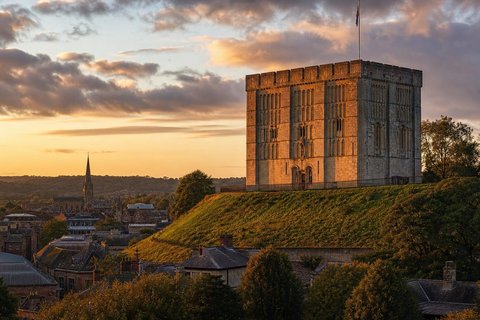 Early 1100sCastle keepNorman stone keep on its artificial mound above the market.
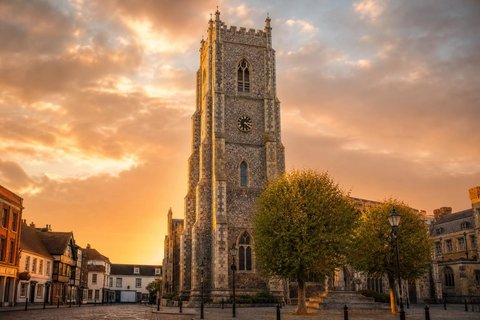 1400sSt Peter MancroftA large town church beside the market, with a tall tower.
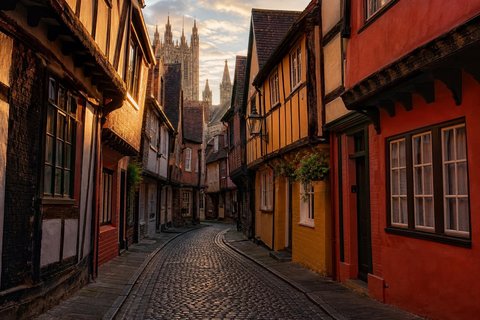 1500sElm HillTimber-framed houses rebuilt after a great fire.
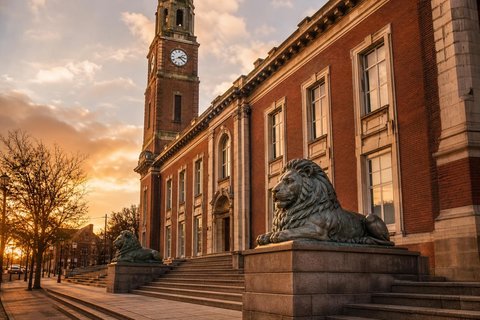 1930sCity HallBrick civic building with a clock tower and bronze lions.
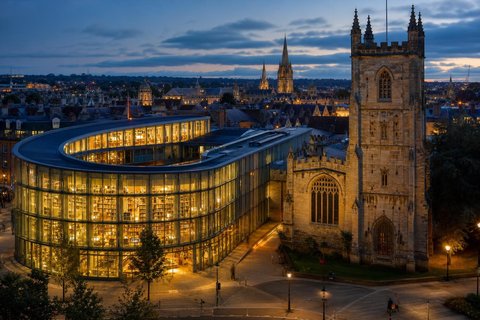 2001The ForumGlass-fronted library facing the old church.