Peel-Apart Film and Pinhole Cameras: FP-3000B, FP-100C and After 2016
Peel-apart instant film in pinhole cameras: Fujifilm FP-3000B and FP-100C, pack and sheet holders, exposure at f/335, expired stock and alternatives.
Pinholista editorial team ·
For years, a pinhole photographer with a 4×5 camera could take a picture, pull a tab, count a few seconds and peel off a finished print in the field. It felt like cheating. The speed of Fujifilm’s black-and-white pack film turned the slowest kind of photography into something close to a snapshot, and when the film disappeared, a whole way of working went with it.
Peel-apart film is still talked about in pinhole circles, partly out of nostalgia and partly because nothing has replaced it exactly. Here is how it worked in a pinhole camera, what the exposures looked like, what is left and where to turn instead.
How peel-apart film works
A peel-apart sheet is a sandwich. A negative layer and a receiving sheet sit together in a pack, with a small pod of thick reagent at one end. Pulling the sheet out of the holder drags it between two steel rollers, which burst the pod and spread the reagent evenly between the layers. After the development time, the two layers are peeled apart: the print stays, the negative usually goes in the bin.
The method dates back to the first Polaroid Land camera in 1948, and it lasted in various forms until 2016. The format most pinhole users met was the pack of 3¼ × 4¼ inch sheets, loaded into Polaroid pack cameras or into a pack holder on a large-format camera.
Peel-apart film
Seventy years of pulling a tab
From the first instant camera to the last Fujifilm packs.
AI
1948Polaroid Land cameraThe first instant camera, using peel-apart roll film.
AI
1963Pack filmPolaroid introduces flat film packs, a format Fujifilm later made as well.
AI
2008Polaroid stops film productionFujifilm becomes the main source of pack film.
AI
2016FP-100C endsFujifilm discontinues its last peel-apart film, two years after FP-3000B.
FP-3000B and FP-100C
Two Fujifilm products carried peel-apart pinhole work through its last decade. FP-100C was a colour film rated at ISO 100, with soft, slightly cool colours and a development time of around 90 seconds at room temperature. FP-3000B was black and white, rated at ISO 3000, with deep blacks, a rather coarse grain and a development time of roughly 15 seconds.
ISO 3000FP-3000B, black and white, about 15 s to develop
ISO 100FP-100C, colour, about 90 s to develop
The difference between them is almost exactly five stops, a factor of thirty, and in a pinhole camera that factor decides whether an exposure is a blink or a coffee break. FP-3000B was the film that let pinhole photographers work at the speed of ordinary photography, and the news that Fujifilm had discontinued it was met with real dismay. FP-100C followed in 2016.
Exposure at pinhole apertures
The table below uses a long 4×5 pinhole box at f/335, the deepest camera in the pinhole camera guide, metered with a standard light value for each scene. The factor against f/22 at f/335 is about 232. Times are before any correction for long exposures, which instant film needed too, especially colour.
Approximate pinhole exposure at f/335 by film and light
Scene
FP-100C (ISO 100)
FP-3000B (ISO 3000)
Bright sun (EV 15)
3.4 s
0.11 s
Overcast (EV 12)
27 s
0.9 s
Bright interior (EV 7)
about 15 min
29 s
At a tenth of a second, a pinhole camera is almost a handheld camera. Many people propped the box on a wall, opened the shutter flap with a fingertip and closed it again at once. With FP-100C indoors, on the other hand, a quarter of an hour of exposure followed by a heavy colour shift was normal, and the film was mostly kept for outdoor work. For longer exposures, the Zero Image exposure guides show how the dial calculators handle the same arithmetic.
Holders and cameras
Peel-apart film needs rollers, and that decides the camera. There were three common setups.
A large-format pinhole camera with a 4×5 back takes a Polaroid 405 pack holder, which slides in like a film holder and carries its own rollers.
Single-sheet 4×5 instant film, such as the old Polaroid Type 55 positive/negative, used the Polaroid 545 holder, loaded one sheet at a time.
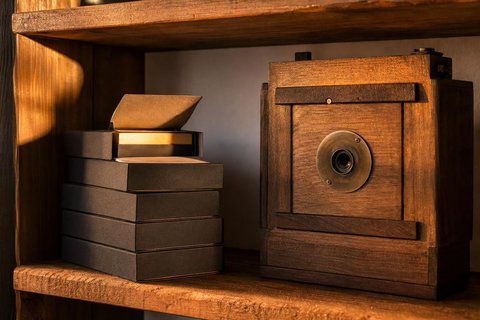
A converted Polaroid pack camera, with the lens replaced by a pinhole plate, keeps the original back and gives a compact, self-contained instant pinhole camera.
The converted pack camera was the favourite home project. The folding bellows of the old 100-series Land cameras gave a focal length of around 110 mm, the shutter could be removed and a brass pinhole fitted in its place, and the result folded down small enough to carry all day. The pack holder rollers needed cleaning every few packs, as dried reagent left marks on the prints.
The speed of FP-3000B turned the slowest kind of photography into something close to a snapshot.
What is left
Packs of both Fujifilm films still circulate, mostly between collectors. Their age is the main problem. The reagent is a paste in a sealed pod, and over the years it thickens, dries along the edges or separates. Typical faults are white patches where the paste did not reach, streaks from uneven spreading and fogged corners. Kept in a fridge, a pack can still give usable pictures, though nobody can promise how many.
Before loading old peel-apart film in a pinhole camera, test one sheet at home under a bright lamp with a short exposure. If the paste spreads to every edge and the blacks come up, the rest of the pack is worth carrying out. If not, the sheets still make interesting abstract pictures for the scanner.
Hand-made peel-apart film has been produced in small batches for Polaroid pack cameras in recent years, sold under names such as One Instant. Such films are slow to make and in limited supply, so availability and speed should be checked with the maker before planning a pinhole session around them.
Warm it up
Instant chemistry slows down in the cold. Below about 15 °C, development times stretch and blacks weaken. A pack carried in an inside pocket, and a developing sheet held against the body, give noticeably better results on a winter day.
Alternatives in a pinhole camera
Nothing quite matches the peel-apart workflow, but several materials come close in one respect or another. Integral instant film, such as Instax Wide or current Polaroid film, develops on its own after it leaves the camera, yet it is slower than FP-3000B and needs a camera body built around its ejecting mechanism. Home-built pinhole cameras for Instax exist, usually with the rollers taken from a broken camera.
Direct positive paper gives a unique positive straight from the camera, much as a peel-apart print did, though it needs trays and a changing bag or darkroom. Ordinary paper negatives remain the cheapest choice, and they can become cyanotype prints in the sun with no enlarger at all. Digital pinhole, with a body cap on a mirrorless camera, gives the instant check that peel-apart film once provided, without the fine charm of a peeled print still wet in the hand.
The negative half of a peel-apart sheet is worth a last word. It was usually thrown away, but the negative of FP-100C could be cleared with bleach and kept, and some pinhole photographers scanned those torn, gooey negatives rather than the prints, prizing the ragged edges where the reagent had stopped.
FAQ
Frequently Asked Questions
When was Fujifilm FP-3000B discontinued?
Fujifilm ended production of FP-3000B, its fast black-and-white pack film, around 2014, two years before it announced the end of the colour FP-100C in 2016. Packs dated before that still turn up, but by now all of them are well past their printed expiry date, and the developing reagent in the pods has had years to thicken or dry out. Results range from usable to completely blank.
Can expired FP-100C or FP-3000B still be used in a pinhole camera?
Sometimes. Film stored cold ages more slowly, and a pack kept in a fridge may still give pictures with weak edges, uneven development or colour shifts. Pull the tab slowly and evenly, keep the pack warm while it develops and expect some sheets to fail. In a pinhole camera, where every exposure takes time to set up, it is sensible to test the first sheet before carrying the pack out.
Is a special back needed to use pack film in a pinhole camera?
Yes. Pack film needs a holder with rollers that spread the reagent as the sheet is pulled out. Polaroid made the 405 pack holder for 4×5 cameras, and many large-format pinhole cameras accept it. Smaller pinhole cameras built around a Polaroid Land pack camera use the original back instead. Without rollers the chemistry never spreads and nothing develops.
What is the closest alternative to peel-apart film today?
For a one-off positive straight from the camera, direct positive paper comes closest in spirit, though it needs a darkroom or a changing bag and trays. For instant results, integral films such as Instax Wide or Polaroid's current film work in pinhole cameras designed around them. Small-batch hand-made peel-apart film has also appeared for old pack cameras, in limited quantities.
Why was FP-3000B so popular with pinhole photographers?
Speed. At ISO 3000 it was about five stops faster than an ISO 100 film, which turned the long exposures of a pinhole camera into fractions of a second in daylight. That made handheld or nearly handheld pinhole shots possible, gave quick proofs in the field and allowed people and moving water to be recorded without the usual blur of a long exposure.
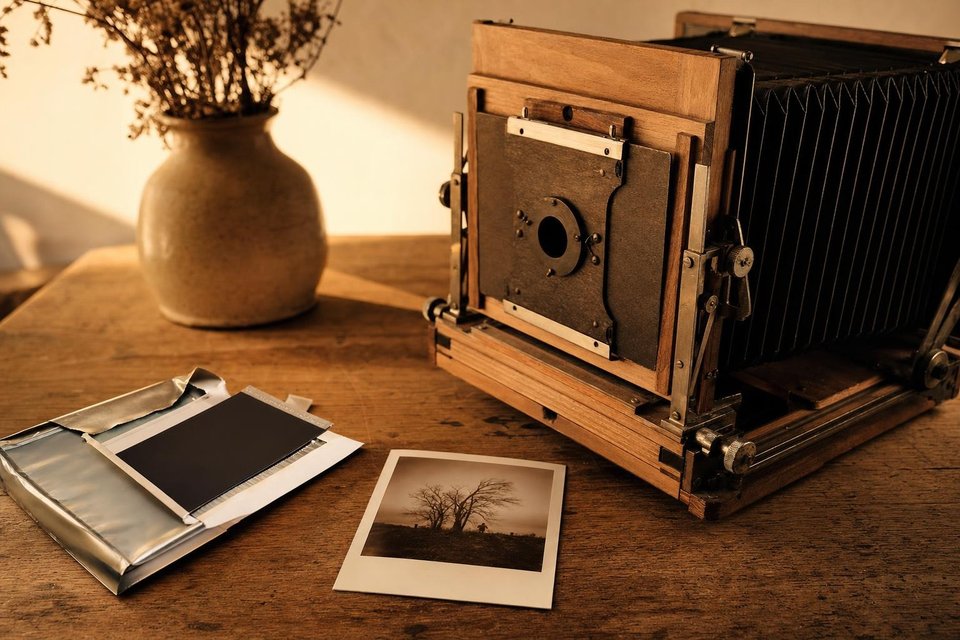
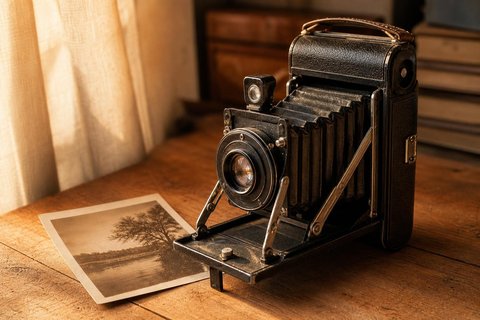 1948Polaroid Land cameraThe first instant camera, using peel-apart roll film.
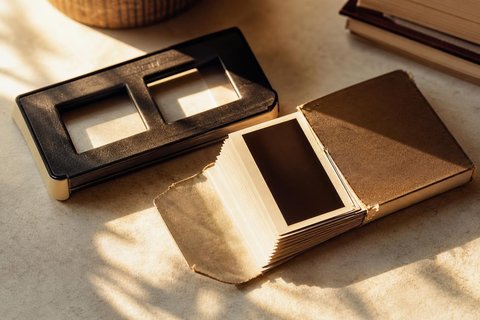 1963Pack filmPolaroid introduces flat film packs, a format Fujifilm later made as well.
 2008Polaroid stops film productionFujifilm becomes the main source of pack film.
 2016FP-100C endsFujifilm discontinues its last peel-apart film, two years after FP-3000B.