Camera
Instant Pinhole Camera: First Shots on SX-70, Polaroid and Instax Integral Film
Pinhole photography on instant film: SX-70, 600, i-Type and Instax, how integral film behaves in a pinhole box, exposure and what to check before buying.
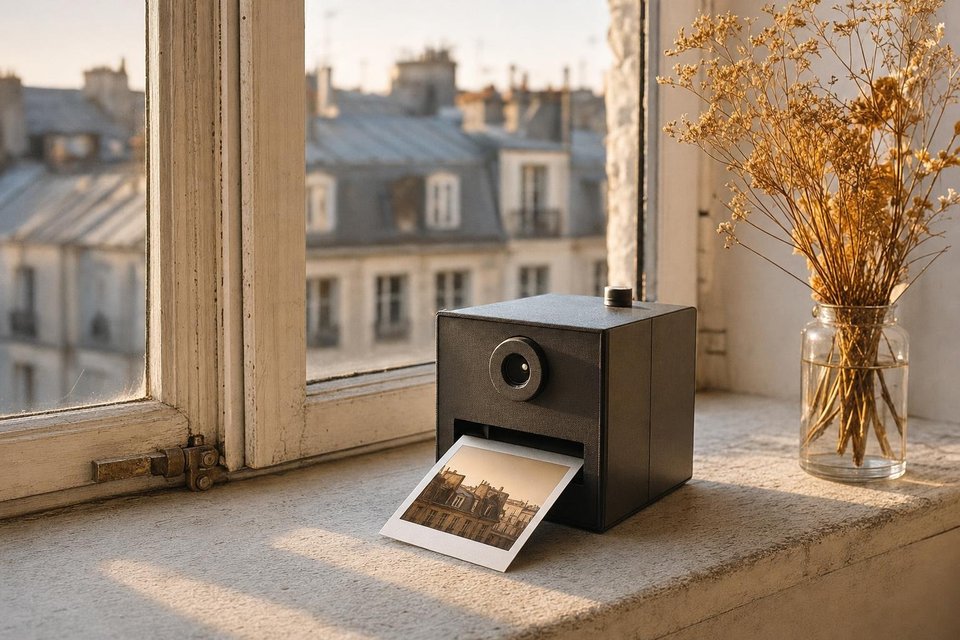
An instant pinhole camera gives back the one thing ordinary pinhole work keeps from you: the result, right away. The frame comes out of the box, develops on a table in a few minutes and settles the question of whether the exposure worked before the light has changed. For anyone learning pinhole exposure, that loop is a remarkably fast teacher.
It also has quirks that film and paper negatives do not share. Instant film has a fixed speed, little latitude, its own appetite for temperature and, in the case of Polaroid, a habit of coming out mirror-reversed. Knowing those quirks before the first pack goes in saves a lot of expensive frames.
How integral film works in a pinhole box
Integral instant film carries everything it needs inside each frame: the light-sensitive layers, the developing reagent in a pod along one edge and the image-receiving layer. After exposure, the frame must pass between a pair of rollers that burst the pod and spread the reagent evenly. Without that step there is no picture at all.
That is why a pinhole camera for integral film is more than a box with a hole. It either includes its own roller mechanism and ejection slot, or it is built around a modified instant camera or back that already has one. A home-made box can still work if the frame is fed through a separate roller unit in the dark, though that is fiddly.
Polaroid integral film, SX-70, 600 and i-Type alike, is exposed from the front, the side the picture is viewed from. Polaroid's own cameras put a mirror in the light path to correct this. A plain pinhole box does not, so every frame comes out reversed left to right. Instax is exposed from the back and reads correctly.
SX-70, 600, i-Type and Instax compared
The choice of film decides the frame size, the cost per picture and the exposure. SX-70 integral film is the slowest of the Polaroid range, made for the folding SLR cameras of the 1970s, and it suits a pinhole camera better than its reputation suggests, because the longer exposures are easier to time by hand.
| Film | ISO | Meter at f/22 | Time at f/192 |
|---|---|---|---|
| Polaroid SX-70 | 160 | about 1/80 s | about 1 s |
| Polaroid 600 | 640 | about 1/320 s | about 1/4 s |
| Polaroid i-Type | 640 | about 1/320 s | about 1/4 s |
| Fujifilm Instax | 800 | about 1/400 s | about 1/5 s |
The meter readings follow the old sunny-day rule, f/16 at one over the ISO, converted to f/22. Real light varies, so treat the table as a sense of scale, not a recipe. What stands out is how short the times are with the faster films. In full sun, a pinhole camera loaded with Instax or 600 film needs a fraction of a second, which is hard to give with a swinging shutter. Dull days, shade and interiors suit those films far better.
Peel-apart instant film is gone. Fujifilm dropped the black-and-white FP-3000B around 2014 and ended the colour FP-100C, the last peel-apart pack, in 2016, which leaves integral film and Instax as the realistic options for an instant pinhole camera today.
Working out exposure
The method is the same as for any pinhole camera. Meter at f/22 with a hand-held meter or a phone app set to the film’s ISO, then multiply by the square of the pinhole f-number divided by 22. At f/192 the factor is about 76. The pinhole camera guide shows how the f-number follows from the hole size and the depth of the box, and the Zero Image exposure guides cover the dial method that many people prefer to arithmetic.
The Ilford correction in the calculator does not apply to instant film. For Polaroid and Instax, use the uncorrected figure as a starting point and bracket longer on exposures above a second or two. Instant film has less latitude than colour negative, roughly a stop either way before highlights burn out or shadows block up, so bracketing the first frames is cheaper than guessing.
Temperature matters too. Polaroid film develops slowly and turns cool and blue in the cold, and warm and soft in the heat. Keeping the ejected frame in an inside pocket while it develops on a winter day helps a great deal.
Buying a pinhole camera for instant film
Most pinhole cameras on the market are built for 120 or 35 mm. The instant ones are a smaller group: wooden or plastic bodies with an Instax back, adapted Polaroid cameras with the lens replaced by a pinhole, and the occasional kit. Before you buy a pinhole camera for instant film, check a few points.
- The exact film format it takes, since Instax Mini, Square and Wide, and the Polaroid formats, do not swap
- Whether processing rollers are built in or need a separate back
- A stated pinhole diameter or f-number, so exposure can be calculated
- A shutter that closes firmly, which matters with fast film and short times
- A tripod thread or a flat, stable base
Handling a camera before buying is worth a trip. Specialist analogue shops are the best place for it, and Supersense in Vienna, a shop given over to analogue and instant photography, is one of the better known. Many general camera stores also carry instant film and can order unusual bodies.
First shots
The first pack is best spent outdoors on a bright, overcast day, with a subject that will not move: a doorway, a tree, a parked bicycle. The light is even, the exposures land near a second with faster film, and the result is easy to judge against the scene.
Expect softness, gentle vignetting and colours that lean warm or cool with the temperature. Expect the first frame or two to be wrong as well. The value of an instant pinhole camera is that the error shows up on the spot, and the next exposure can be corrected while standing in the same light.
A useful habit is to write the exposure time and the light on the white border with a fine marker as soon as the frame is dry. After a pack or two, those notes become a personal exposure table for that camera and that film, more reliable than any rule of thumb, because they account for the actual pinhole, the actual shutter and the film’s own reciprocity behaviour.
Instant film beside the alternatives
Instant film is the most expensive way to make a pinhole picture, frame for frame. Paper negatives cost a fraction as much and also give quick results, but they need a darkroom or at least a changing bag and trays, and at around ISO 3 to 6 they demand very long exposures. Roll film in a small wooden box like the Miru is cheaper per frame again, with the wait for development. A digital body with a pinhole cap, covered in the piece on the Skink pinhole lens, gives instant feedback at no cost per shot, though without the physical print.
For a first season of pinhole work, the instant camera earns its cost as a teaching tool. Once exposure becomes second nature, many people move the bulk of their shooting to roll film and keep the instant camera for days when a print in the hand matters more than the price.

Frequently Asked Questions
Why do Polaroid pinhole pictures come out mirror-reversed?
Polaroid integral film is exposed from the same side it is viewed from. Polaroid's own cameras correct for that with a mirror inside the body, which flips the image before it reaches the film. A simple pinhole box has no mirror, so text reads backwards and left and right are swapped. Most people accept it as part of the look; a mirror-reversed scan fixes it on screen, though not on the print itself.
Which instant film is easiest for a first pinhole attempt?
Instax is usually the easiest start. It is widely sold, comparatively cheap per shot, fairly tolerant of exposure error and comes out the right way round. Polaroid 600 and i-Type film share the same ISO 640 speed and give the larger square frame, but they cost more per picture and react more to cold. SX-70 film, at ISO 160, needs roughly four times the exposure of those.
Does instant film suffer from reciprocity failure?
Yes, every film loses sensitivity on long exposures, and instant film is no exception. The manufacturers do not publish a simple correction formula for pinhole-length times, so the practical answer is testing. Bracket the first few frames, note the conditions and the times, and adjust. Short exposures in bright light are the most predictable starting point, which is another reason to shoot the first pack outdoors.
What should be checked before buying an instant pinhole camera?
Confirm which film it takes, since Instax Mini, Square, Wide and the Polaroid formats are not interchangeable. Ask whether the camera processes the film through rollers or needs a separate back. Look for a stated pinhole size or f-number, a shutter that closes positively and a tripod thread. Finally, check the seller can explain how the dark slide or first cover sheet is handled.
Where can instant film and pinhole cameras be seen in person?
Specialist analogue shops are the best places to handle cameras before buying. Supersense in Vienna is one well-known example, a shop given over to analogue and instant photography. Local camera stores and film labs often stock instant film and can sometimes show a pinhole camera or two, and pinhole meet-ups on Worldwide Pinhole Photography Day are another chance to try one.