Technique
Pinhole Portraits: Why They Are Harder Than They Look, From Stillness to Light
Pinhole portraits explained: long exposures, keeping a sitter still, wide-angle distortion, backgrounds that move, and a worked exposure table for window light.
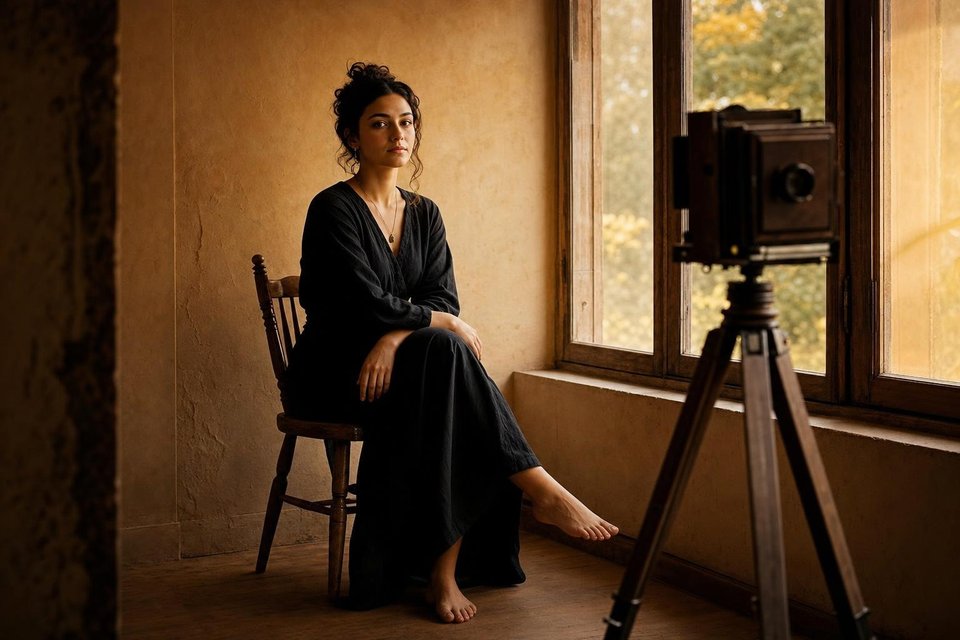
Landscapes wait. People do not. A hill stays put for a two-minute exposure and nobody minds, but a person asked to hold still for even ten seconds starts to breathe, sway, smile and stop smiling. Pinhole portraits therefore carry a strain that pinhole landscapes never do, and the technical problems are only half of it.
The other half is human. Asking someone to sit for a photograph that will not look sharp, made with a box that has no lens, and then to stay still for a count of twenty, takes a certain confidence. This page goes through both halves: the physics of long exposures, wide angles and distance, then the practical craft of light, support, posing and counting.
Why a Portrait Takes So Long
A typical pinhole camera works somewhere around f/150 to f/250. That is roughly five and a half to seven stops slower than f/22, and portraits are usually made in softer light than landscapes. Put the two together and a portrait by a window on ISO 400 film easily needs five to ten seconds, before any correction for film.
The table below starts from a meter reading at f/22 in a few common portrait situations and converts it for a camera at f/192. The corrected column uses the published reciprocity rule for Ilford HP5 Plus, raising the time in seconds to the power of 1.31.
| Situation | Meter at f/22 | Time at f/192 | HP5 Plus corrected |
|---|---|---|---|
| Open shade outdoors | 1/125 s | 0.6 s | 0.6 s |
| Overcast doorway | 1/60 s | 1.3 s | 1.4 s |
| Bright window, close | 1/15 s | 5.1 s | 8.4 s |
| Window, across the room | 1/8 s | 9.5 s | 19 s |
| Dim interior | 1/4 s | 19 s | 48 s |
Those figures explain why so many pinhole portraits are made outdoors or right beside a window. Every step back into a room roughly doubles the time, and at forty-odd seconds only a very patient sitter, propped against something, will come out recognisable.
Nineteenth-century studios faced exactly this problem. Early portrait sitters often had a hidden metal stand behind them, with a clamp that rested against the back of the head and kept it steady through exposures that could last many seconds. Pinhole photographers have quietly reinvented the idea with chair backs, walls and door frames.
Distance and the Wide-Angle Face
Most pinhole cameras are wide. A 25 mm box on 35 mm film sees about 82 degrees across the diagonal, and even a 50 mm box on 6×6 film sees almost as much. To fill the frame with a face, the camera has to come very close, and close-up wide-angle views enlarge whatever is nearest: the nose, the chin, a hand resting on a knee.
| Framing (subject height) | 25 mm on 35 mm, upright | 50 mm on 6×6 |
|---|---|---|
| Head and shoulders (0.6 m) | 0.4 m | 0.5 m |
| Waist up (1 m) | 0.7 m | 0.9 m |
| Full figure (2 m) | 1.4 m | 1.8 m |
Working out these distances in advance helps, but people still get it wrong in the field, usually by standing too close and cutting off the top of a head. With no viewfinder, the frame lines on the camera and a little tape measure in a pocket are the only defence. Stepping back and accepting a smaller figure in a larger setting almost always produces a better picture than forcing a close-up.
Background, Movement and Stillness
The background carries more of a pinhole portrait than it does in lens photography. With no shallow depth of field to blur it away, every wall, tree and lamp post is rendered with the same softness as the face. A good pinhole portrait is therefore partly a picture of a place, and choosing the place deserves as much thought as choosing the light.
Movement adds a second layer. A still sitter in front of a still background gives something close to a conventional portrait, with a pinhole softness. A sitter who moves against a still background turns into a ghost. The most striking combination is often the reverse: a sitter who holds still while the world moves behind, with traffic, crowds, water or branches dissolving into streaks around a calm figure.
A pinhole portrait records how long someone stayed, not just what they looked like.
Group walks such as the yearly Worldwide Pinhole Photography Day are a good place to practise, because everyone present understands the long count. A write-up of one such day is in the WPPD aftermath.
Choosing Film for People
Speed matters more for portraits than for any other pinhole subject. An ISO 400 film such as HP5 Plus keeps window-light times in single figures, and pushing it a stop in development halves them again at the cost of some grain and contrast. Slow films and paper negatives belong outdoors in bright shade. Paper rated around ISO 3 to 6 turns a window portrait into several minutes, which only works with a sleeping child or a sitter who enjoys meditating.
Format matters too. A larger negative needs less enlargement, so the softness of the pinhole shows less on the print, and a 6×6 or 4×5 portrait often looks more finished than one on 35 mm. The price is a longer box, a slower f-number and a longer count. Many photographers settle on medium format as the middle ground, with a camera short enough for indoor light and a negative large enough to print well.
A Working Method for the Sitter
Most problems with pinhole portraits can be avoided with a short routine before the shutter opens.
- Put the camera on a tripod or a firm surface, never in the hand.
- Give the sitter something to lean on: a wall, a chair back, a tree trunk.
- Ask for a relaxed, neutral expression rather than a smile, which fades within seconds.
- Let the sitter fix their eyes on the pinhole or another steady point.
- Count aloud, so the sitter knows how long remains.
- Make two or three exposures; one of them is usually the steadiest.
A digital camera fitted with a pinhole body cap shows within seconds whether a framing works and how much a sitter moves. A dozen trial frames cost nothing and save a roll of film.
Exposure itself follows the same arithmetic as any other pinhole subject; the Zero Image exposure guides include a calculator and a method for printing a pocket card. The shape and size of the box matter too, and the pinhole camera guide explains how focal length decides the angle of view. Some photographers go the other way and exaggerate the distortion deliberately with a curved film plane, as in anamorphic pinhole photography.
The technical side of pinhole portraits can be learned in a few rolls. Putting people at ease takes longer, and it is the part that decides whether a picture has any life in it. A sitter who trusts the photographer sits more calmly, and calm shows on the negative.
Frequently Asked Questions
What is the best light for a pinhole portrait?
Bright, soft light from one side, such as a large window facing away from the sun or an open doorway on an overcast day. It keeps exposures short enough for a sitter to manage and models the face gently. Direct sun shortens the time further but makes people squint, while a dim room stretches the exposure to the point where almost nobody can stay still.
Should a sitter look at the camera during a long exposure?
It helps to give the eyes a fixed point, and the pinhole itself works well because it is small and does not move. Eyes that wander leave a soft, ghostly gaze. A sitter can blink normally during exposures of several seconds without much effect, since each blink lasts only a fraction of the total. Asking someone not to blink usually makes them tense and causes more movement.
Can pinhole portraits be made with a digital camera?
Yes, and it is a good way to practise. A pinhole body cap gives instant feedback on distance, framing and movement, and each attempt costs nothing. The short distance to the sensor means a very wide view, so the camera has to be quite close. Once the timing and framing feel natural, the same habits carry over to film with very little change.
How close should a pinhole camera be for a head-and-shoulders portrait?
It depends on the focal length and the format. With a 25 mm deep camera on 35 mm film held upright, a head-and-shoulders frame needs the camera about 40 cm from the sitter. A 50 mm camera on 6x6 film needs a little over half a metre. At those distances the nose and chin come out noticeably larger, which is why many photographers step back and accept a smaller face.